

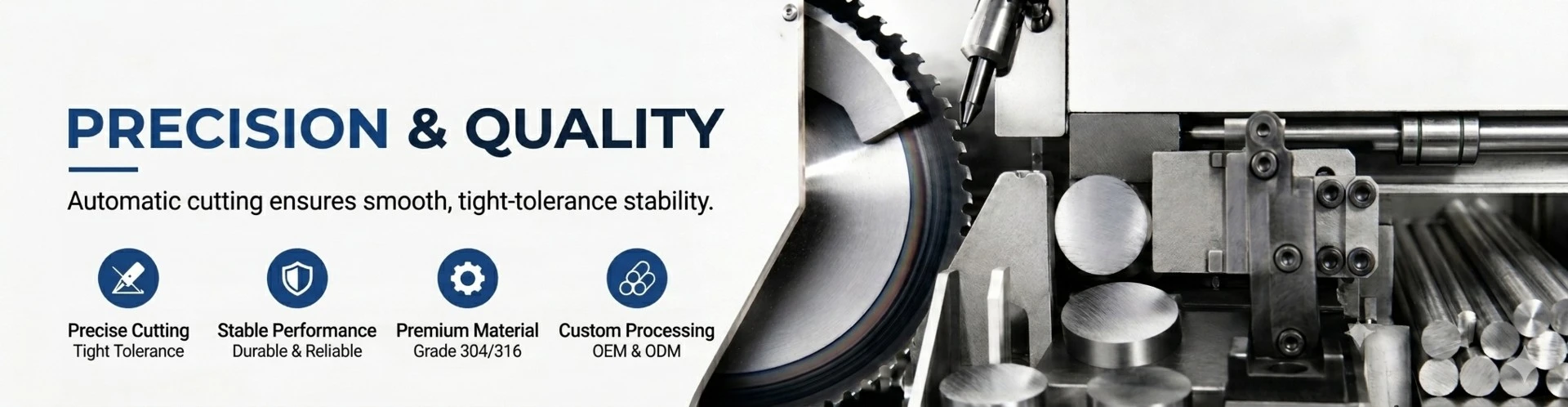

Every metal fabrication workshop relies on quality saw blades to cut bars, tubes and profiles efficiently. However, many buyers make avoidable mistakes during procurement, which lead to premature blade wear, unexpected breakage, poor cut finish and higher overall machining costs. These errors are not always about picking a cheap product; most come from mismatched specifications, ignored operating conditions and incomplete communication with suppliers. Recognising these common pitfalls can help metal processors select the right band saw and circular saw blades and reduce unnecessary downtime.
The first widespread mistake is choosing blade grade purely based on price instead of workpiece material. Some buyers select standard M42 bi‑metal band saw blades or plain HSS circular blades for hard, abrasive or heat‑resistant materials to save upfront cost. While M42 works well for carbon steel and ordinary alloy steel, it struggles with high‑hardness mold steel, stainless steel and superalloys. Under these conditions, teeth burn rapidly and chip easily. In such cases, M51 high‑cobalt bi‑metal blades or carbide‑tipped saw tools are the correct choice. Although the unit price is higher, their longer service life reduces blade replacement frequency and total cutting cost.
A second frequent error is improper selection of tooth pitch or TPI. Many customers only focus on blade outer diameter and thickness, ignoring tooth geometry. The basic rule of metal cutting is to keep at least two to three teeth engaged with the workpiece at all times. Using coarse teeth on thin‑wall tubes will rip off teeth. Too fine a pitch on large solid bars causes chip clogging, overheating and dulling. Variable pitch blades are designed to reduce vibration for mixed cross‑sections, but they are not a universal solution. Buyers should provide the actual material type and cross section size so suppliers can recommend the correct tooth form.
Thirdly, overlooking machine flange and mounting hole requirements is a costly mistake, especially for HSS cold saw blades. Customers sometimes reuse hole patterns from smaller‑bore blades for larger central bores. This creates an extremely thin wall between locating pin holes and the central bore. Under high rotational speed and clamping force, microcracks appear around holes during heat treatment or operation, which may eventually cause blade failure. Always confirm the PCD, pin hole diameter and wall thickness. Custom hole layouts must be verified by the supplier's technical team before production.


Another common mistake is neglecting operating parameters and cooling conditions. Some buyers assume the same blade will perform equally well on different machines. In reality, band tension, cutting speed, feed rate and coolant quality directly decide blade life. Even premium blades will fail quickly if run at excessive speed or without sufficient coolant. Dry cutting of HSS or bi‑metal blades is not recommended in most metal cutting applications. Buyers should match blade selection with machine setup and maintenance routines.
Many purchasers also underestimate the importance of consistent raw material and quality control. Some low‑cost saw blades use inferior backing steel or unstable HSS tips. These products may look identical on the surface, but they suffer uneven hardness, poor flatness and inconsistent tooth grinding. They may work for a short time, yet the risk of sudden fracture is much higher. Reliable manufacturers carry out flatness checks, hardness testing and tooth inspection for every batch.
Last but not least, ignoring storage and break‑in requirements. New blades need proper running‑in at reduced load to protect tooth tips. Improper storage such as stacking, heavy compression or humid environments leads to rust and permanent deformation, even before first use.
At JINZHI STEEL, our technical team supports global metal fabricators in blade selection. We supply bi‑metal band saw blades (M42, M51), Vapo‑coated HSS circular saw blades and carbide tipped saw blades, with custom dimensions and pin hole layouts. We help customers avoid specification mismatches and select the most cost‑effective solution according to their actual cutting tasks.
Choosing saw blades is not just buying a consumable item. It is matching tool performance to your material, machine and production goals. Avoiding these typical purchasing mistakes helps workshops achieve stable cutting quality, longer blade life and lower total operating cost.
Short preview summary: Many metal fabricators encounter early blade damage due to wrong grade selection, unsuitable tooth pitch, unchecked mounting hole design and ignored cutting parameters. Learn these typical buying mistakes to reduce breakage and cut your machining cost.